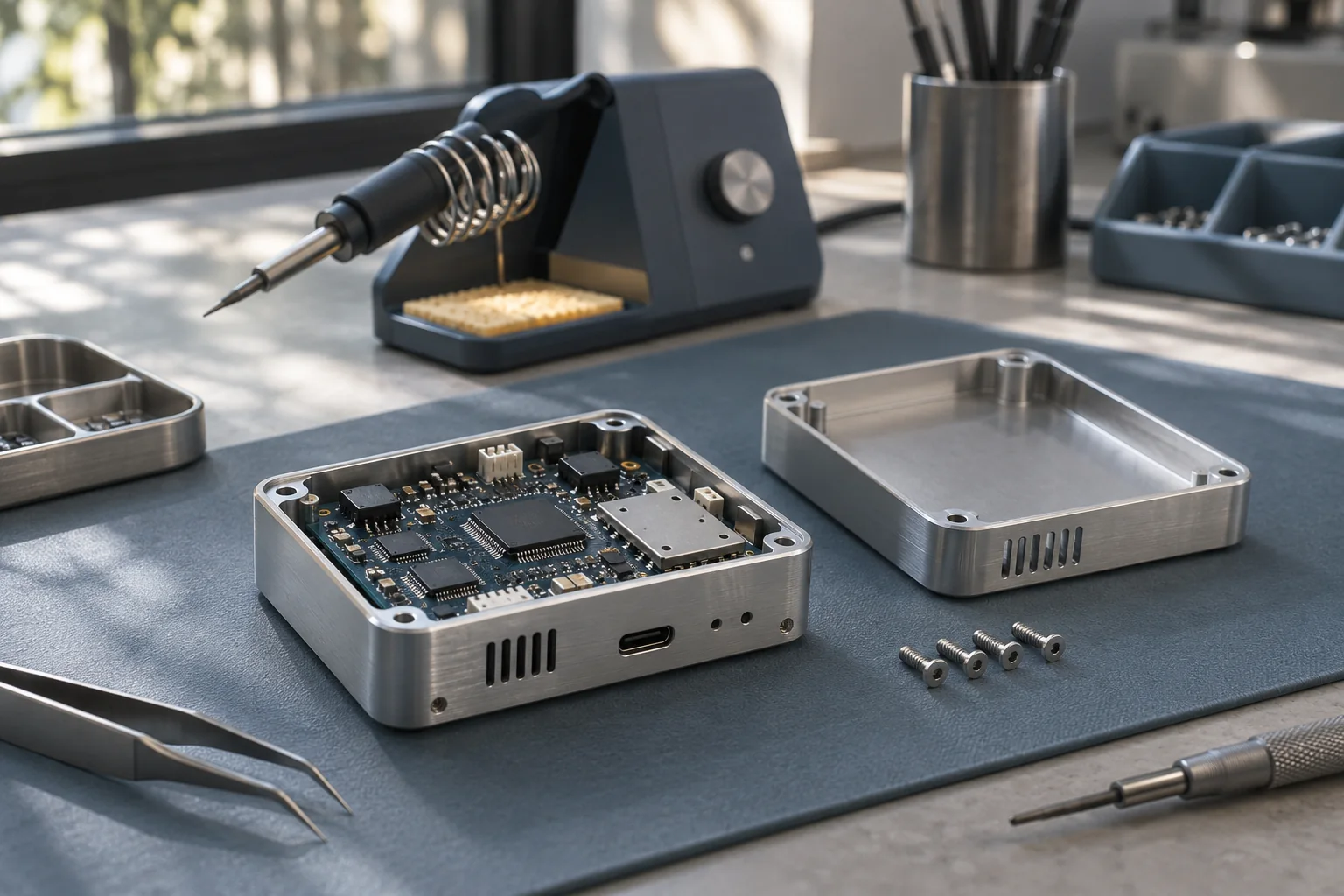
Which manufacturing changes preserve the approved product, and who can demonstrate that they do?
Define approved alternatives at component and firmware level; “equivalent” needs an engineering basis.
Measure first-pass yield before rework, and keep test coverage separate from the percentage of units tested.
Validate radio behaviour in the final enclosure; a successful bare-board demonstration leaves an important gap.
Market evidence
Reporting periods and statistical scope are shown for each figure.
- 2025 · ChinaElectronics manufacturing profit-to-revenue ratio
4.3%
Do not assume a low assembly quote contains unlimited engineering, test development or change support.
Sector-wide accounting ratio; not an EMS margin, quotation markup or estimate of negotiable savings.
Source 1- 2024 · Chang’an, DongguanElectronic-information output, enterprises above designated size
232.61RMB billion
Electronics and enclosure-related processes coexist locally; their change interfaces still need explicit management.
Source 3
A production quote buys a defined version of the product
MIIT reports a 4.3% profit-to-revenue ratio for China’s electronics manufacturers above designated size in 2025. This is a broad sector measure, not a contract manufacturer’s margin. The relevant commercial question is what engineering, testing and change support a particular quotation actually funds. 1
A useful comparison identifies what the quoted assembly service includes: purchasing against approved manufacturer part numbers, programming, test execution, failure analysis and rework. If one quotation assumes a finished test method and another includes developing it, their unit prices answer different questions. The cost to compare is the cost of an accepted, traceable and supportable unit.
MANUFACTURING GEOGRAPHY
- Bao’an, Shenzhen
PCB, communications, sensors and intelligent-terminal ecosystem documented by the district investment authority. 2
- Chang’an, Dongguan
Electronic-information manufacturing alongside hardware and mould processes; relevant to the relationship between electronics and enclosure production. 3
An equivalent component can have a different commercial footprint
A replacement device may fit the footprint yet differ in start-up behaviour, timing, power consumption or software support. Even a passive component can require attention to its specified electrical behaviour and operating conditions. The appropriate review depends on the circuit; a purchasing description alone cannot determine interchangeability.
An engineering change should connect the proposed part to its reason, affected requirements, firmware implications, required verification and the production lots that receive it. The commercial question is whether the alternative reduces exposure after those costs are included. It may be worth approving a second source before a shortage, while a last-minute price substitution may offer little value once revalidation and field-support complexity are recognised.
Separate approved alternatives from emergency deviations. The former can become a controlled purchasing option; the latter should have a defined limit and an identified technical decision-maker. Neither should silently become the permanent bill of materials.
Testing every board is not testing everything
A powered LED can establish that one function responds. It does not establish every sensor, communication path or power state. Seeed’s manufacturing documentation separates functional, electrical-performance and reliability testing and states that the scope is project-specific. Firmware programming and fixture development are also distinct services. 4
Test coverage therefore needs a requirement-to-evidence map: what is measured, what constitutes a pass and which faults the method is intended to detect. A fixture adds development and maintenance cost but may make repeated execution more consistent. The correct choice depends on the failure modes and volumes, not a universal demand for the most elaborate tester.
An extra test step earns its place when the expected downstream cost it avoids justifies its fixture, execution and maintenance cost. That judgement needs the probability of the relevant fault, the test’s ability to detect it and the consequence of escape—not just the seconds added to the line.
First-pass yield should exclude units that pass only after rework. Otherwise a satisfactory final pass rate can conceal poor process performance and additional handling. Record failure categories, repair actions and retest results by hardware and firmware revision. Those distinctions help separate a design issue from an assembly defect or a faulty test limit.
The enclosure belongs in the electronics discussion
Bao’an’s industrial materials identify PCB and intelligent-terminal capabilities; Chang’an’s work report documents a substantial electronic-information sector alongside machinery, hardware and mould activity. Those nearby capabilities are useful when changes cross the boundary between the board and the housing. 2 3
Espressif’s hardware guidance explicitly addresses antenna placement and the influence of the final enclosure, recommending end-product checks of communication performance. Its dimensions are module-specific guidance, not universal rules for every wireless product. 5
The commercial implication is to assess a housing change as more than a tooling change. A new material, coating, internal bracket or board position can require additional technical review. Freeze the relevant configuration for testing and record which enclosure revision accompanies each electronics build. Qualified radio and product-compliance specialists should decide the required evidence for the destination market.
Preserve the ability to explain every shipped unit
Treat the manufacturing definition as a connected record: approved parts, board revision, firmware, programming data, enclosure and test method. A change to one item should expose the others that may be affected.
A supportable product requires the ability to explain what is inside a shipped unit, why it was approved and how it was tested. China’s supply-chain speed becomes an advantage when alternatives are turned into controlled decisions; without that discipline, speed can multiply versions faster than a small hardware team can support them.
Changes that look local but affect the complete product
| Change | Potential consequence | Decision basis |
|---|---|---|
Replace a key IC | Firmware or electrical behaviour changes | Requirement-specific engineering review |
Move the antenna or alter housing | Radio performance changes | Final-configuration technical evidence |
Shorten the production test | Less time per unit, different fault coverage | Coverage map and failure economics |
Allow reworked units | Additional handling and possible reliability questions | Defined repair authority, traceability and retest criteria |
Where to intervene
Build a controlled alternatives register
Before alternative parts enter purchasing
Classify alternatives by circuit function and validation burden.
Connect each approval to hardware, firmware and affected lots.
- Working output
An engineering-owned substitution record.
- Decision test
The technical owner approves evidence and permitted use.
Expose the economics of the test
Before agreeing production pricing
Map requirements to test steps and pass criteria.
Separate fixture development, execution, diagnosis and rework in quotations.
- Working output
A costed test scope and revision-linked failure record.
- Decision test
Engineering accepts coverage and operations accepts execution time.
Measures that make the decision testable
- First-pass yield by revision
Units passing the defined test on their first attempt divided by units first tested.
Establish a revision-specific baseline; do not merge reworked passes into the numerator.
- Traceable production coverage
Shipped units linked to approved component, firmware and test records divided by shipped units.
Agree traceability requirements with engineering and after-sales support.
- Test escape rate
Confirmed field failures attributable to faults the production test was intended to detect, divided by the relevant shipped population.
Set the observation period and investigation method around product reliability requirements and the cost of unresolved failures.
From analysis to a working brief
XYU can identify manufacturing candidates and organise their responses around the buyer’s controlled product definition. It can clarify purchasing and test-cost assumptions, coordinate authorised technical files and prototypes, and follow up engineering-change questions with suppliers. Where board, enclosure and assembly providers differ, XYU can make dependencies and pending decisions visible. Circuit design, firmware approval, test limits and product conformity remain with the buyer’s technical owners and appointed specialists. The support is intended to help those owners make informed decisions without losing control of the product definition.
Sources & methodology
This analysis draws on the sources below. Figures retain each source’s reporting period, product category and geographic scope. Commercial recommendations and decision frameworks are XYU’s analysis.
- 2025 electronics manufacturing industry performance
Ministry of Industry and Information Technology of China · 30 January 2026
Reported profit-to-revenue ratio for the above-designated-size national electronics sector.
- Bao’an next-generation electronic-information industry
Shenzhen Government / Bao’an Investment Promotion Bureau · 30 June 2025
PCB, communications, sensors and intelligent-terminal industrial context.
- Chang’an government work report: electronics and manufacturing
Chang’an Town Government · 6 March 2025
RMB 232.61 billion 2024 electronic-information output and coexisting machinery/hardware/mould sector.
- PCBA testing solutions: scope and fixtures
Seeed Studio
Distinct test services, project-defined requirements, firmware programming and fixture options.
- Hardware design guidelines: module placement and enclosure influence
Espressif Systems
Module antenna placement, enclosure effects and end-product communication testing.