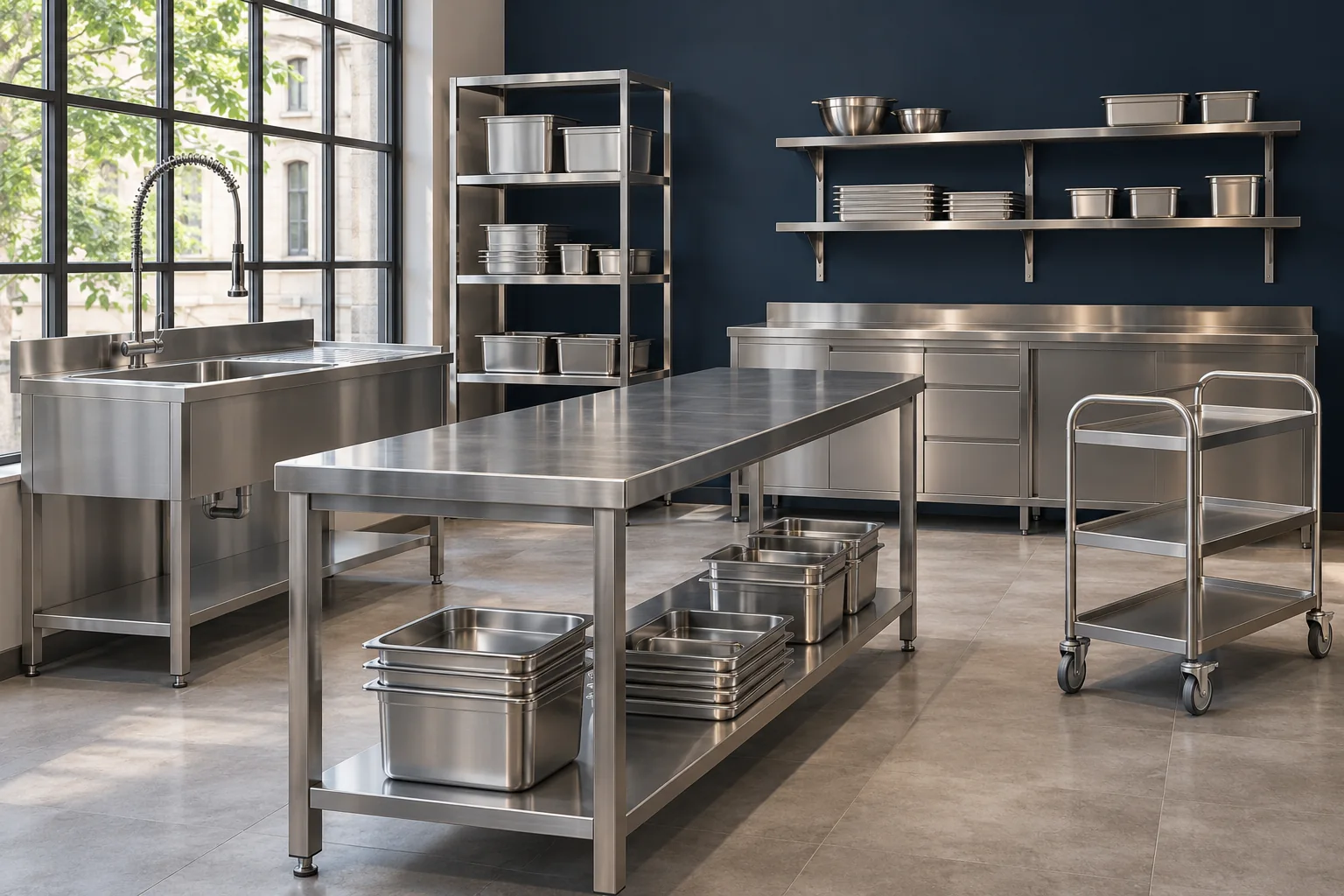
What must be in place for the distributor to support the product after the first service call?
Separate fabricated fixtures from powered equipment; their cost drivers and after-sales obligations differ.
A stainless grade does not establish cleanability, electrical safety or food-contact suitability on its own.
Price installed support: access, spare parts, diagnosis and technician time belong in the commercial model.
Market evidence
Reporting periods and statistical scope are shown for each figure.
- Cluster profile published January 2025 · Boxing County, ShandongReported commercial-kitchen industry scale
35RMB billion annual output
Investigate specialisation within the manufacturing ecosystem.
Reported cluster estimate, not national equipment sales or supplier capacity.
Source 1- Shanghai 2024 surveillance; published March 2025 · Products made or sold in Shanghai; sampled origins included Shanghai, Guangdong and ShandongNon-compliant industrial/commercial electrically heated food-processing products
9 of 30sampled batches
Obtain evidence for the exact powered model and construction.
Defined surveillance sample, not a national failure rate; excludes passive fixtures and refrigeration.
Source 2- 2025 · ChinaCatering revenue growth
+3.2% year on year
Domestic demand does not establish European installation or service suitability.
Nominal catering-service revenue growth, not equipment sales.
Source 3
One catalogue can conceal several different businesses
Boxing offers a documented commercial-kitchen manufacturing ecosystem. 1 The useful question is which product family the proposed partner actually controls. Separate passive fixtures, such as benches and sinks, from refrigeration, heating and food-processing equipment. The first group centres on fabrication and cleanability; powered products add controls, operating performance and service dependencies.
Domestic catering growth provides demand context, but does not establish fitness for a European installation. 3 Build the offer around the distributor’s customer and support capability rather than the number of products available to ship.
MANUFACTURING GEOGRAPHY
- Boxing, Shandong
A documented commercial-kitchen manufacturing cluster, suitable for investigating fabricated stainless-steel products and specific equipment families separately. 1
The work surface is a system of joints and edges
A material-grade label answers only part of the question. Review the food-contact zone, splashback, underside, folds, drain arrangement, welded joints and accessible cleaning surfaces together. Ask how the actual detergents, exposure and cleaning routine affect material and component choice. NSF’s food-equipment framework separates material safety, cleanable construction and product performance. 4
Our recommendation is to review the fixture in its working layout. Can staff clean around it, remove the relevant parts and reach the surfaces where residue collects? Can the proposed sink drain and worktop interfaces be installed as intended? Compare fabrication proposals against those tasks. The cheapest sheet-metal assembly may create an awkward cleaning job, while a more elaborate finish may add cost without improving use. Estimate cleaning labour using the operator’s own observations and wage assumptions under the intended workflow.
Test the model that will actually be sold
Shanghai’s 2024 surveillance found nine non-compliant batches among 30 sampled industrial and commercial electrically heated food-processing products. The sample covered particular products made or sold in Shanghai; it cannot support a national defect-rate claim. 2 Its relevance is the need for model-specific evidence. A document for a different controller, wiring arrangement or model family does not automatically explain the unit being offered.
For refrigerated storage, define the intended ambient conditions, operating temperature, loading and use pattern, then compare appropriate performance evidence for the complete model. The European Commission distinguishes professional storage cabinets from customer-facing display refrigeration and identifies different product scopes. 5 That distinction should be settled before documentation is commissioned. Ask qualified technical specialists to determine the applicable requirements; a useful factory meeting should resolve the precise model and intended application, rather than collect a stack of unrelated certificates.
The gasket is part of the business model
Foster’s maintenance guidance identifies an effective door seal and condenser care as important to refrigeration operation; it also explains replacement and trained-engineer maintenance. 6 Parts requiring attention must be identifiable, accessible and obtainable in the market where the equipment is installed.
Before adding a refrigerated product to the range, have the intended service partner examine gasket removal, controller identification, wiring information, diagnostic access and the proposed spare-parts list. Determine which components can be sourced locally and which depend on the Chinese supplier. Record model and component revisions so a replacement ordered later actually fits. A distributor without the service capability for a complex powered product may have a stronger initial offer in fabricated fixtures, rather than a superficially broader catalogue it cannot support.
Compare cost over an agreed operating scenario
Use a transparent cost model: purchase and delivery, installation adaptations, energy under stated conditions, planned maintenance, spare holdings and service labour. Keep uncertain failure and utilisation assumptions visible. Compare the resulting operating scenarios. For refrigeration, a published energy figure is meaningful only alongside the relevant test conditions and product classification. 5
The service promise also needs a commercial owner. Decide who diagnoses a fault, authorises a part, pays the technician and handles a unit that cannot be repaired economically. Translate the agreed responsibilities into the actual distribution arrangement. This is not simply a longer warranty document: it determines whether an equipment family belongs in the portfolio. If the parts, expertise or access needed to support it remain unresolved, a low factory quotation has not established a viable product business.
Match the product family to the distributor’s operating capability
| Product family | Critical operating issue | Commercial decision |
|---|---|---|
Stainless benches and sinks | Cleanable joints, drainage, installation dimensions and stability | Build a repeatable fabrication and installation offer. |
Refrigerated storage | Temperature performance, energy conditions, seal and condenser access | Approve only with model evidence and a workable service arrangement. |
Powered food preparation or heating | Exact electrical construction, operating duty and technical documentation | Resolve product-specific technical requirements before range expansion. |
Replacement components | Identification, fit, access and availability | Price parts holdings and technical support with the equipment. |
Where to intervene
Choose the product families the business can support
Before committing to a wide equipment catalogue
Separate kitchen tasks requiring passive fixtures from those requiring powered equipment.
Identify installation and service capability needed for each family.
- Working output
A portfolio boundary grounded in use and support economics.
- Decision test
Include only families with a credible operating and after-sales model.
Resolve a complete model and its service dependencies
Before approving a powered model for sale
Connect the exact configuration to technical evidence and operating conditions.
Resolve component identities, access, spare supply and service-cost ownership.
- Working output
A model-specific operating dossier and transparent cost scenario.
- Decision test
Proceed when qualified technical review and the service arrangements cover the intended offer.
Measures that make the decision testable
- Time to restore service
Time from confirmed fault to restoration, separating diagnosis, parts and technician delays.
Operational need and documented service capability.
- Energy per defined operating period
Consumption under recorded loading, ambient and temperature conditions for the exact model.
Comparable test evidence and the customer’s use scenario.
- First-visit repair feasibility
Availability of information, parts and access for priority failure modes.
Documented service review, not an assumed success percentage.
From analysis to a working brief
XYU can organise a focused China visit around the product families and technical questions that matter to the distributor, coordinate manufacturer discussions and obtain model, fabrication and component information. We can support follow-up on service parts, quotations and agreed external assessment, so differences between proposals remain visible. Qualified engineers, laboratories and local service partners assess performance, compliance and repair requirements. The distributor makes the portfolio and warranty decisions; XYU provides the China-side coordination needed to connect those decisions with the proposed manufacturer.
Sources & methodology
This analysis draws on the sources below. Figures retain each source’s reporting period, product category and geographic scope. Commercial recommendations and decision frameworks are XYU’s analysis.
- Commercial-kitchen manufacturing and the Shandong industry association
China Social Work newspaper, published by the CPC Central Social Work Department · 24 January 2025
Primary association interview and cluster profile: Boxing annual commercial-kitchen output RMB 35 billion. This is a reported estimate, not an official national statistical series.
- Shanghai 2024 surveillance of industrial and commercial electrically heated food-processing equipment
Shanghai Institute of Quality Inspection and Technical Research · 31 March 2025
30 sampled batches and nine non-compliant batches; sample channel and manufacturing-origin breakdown. Not a population defect estimate.
- December and full-year 2025 retail sales
National Bureau of Statistics of China · 19 January 2026
Full-year catering revenue grew 3.2% nominally; this is catering-service demand, not equipment sales.
- Food equipment certification: design, material and performance principles
NSF
Material safety, cleanable design and construction, and product performance are distinct elements of food-equipment assessment.
- Professional refrigerated storage cabinets: scope and product requirements
European Commission
Distinguishes professional storage from direct-sales refrigeration and explains the relevant product scopes and energy-labelling context.
- General maintenance guidance for Foster refrigeration
Foster Refrigerator
Door-seal condition, gasket replacement, condenser cleaning and trained-engineer maintenance; manufacturer-specific guidance.