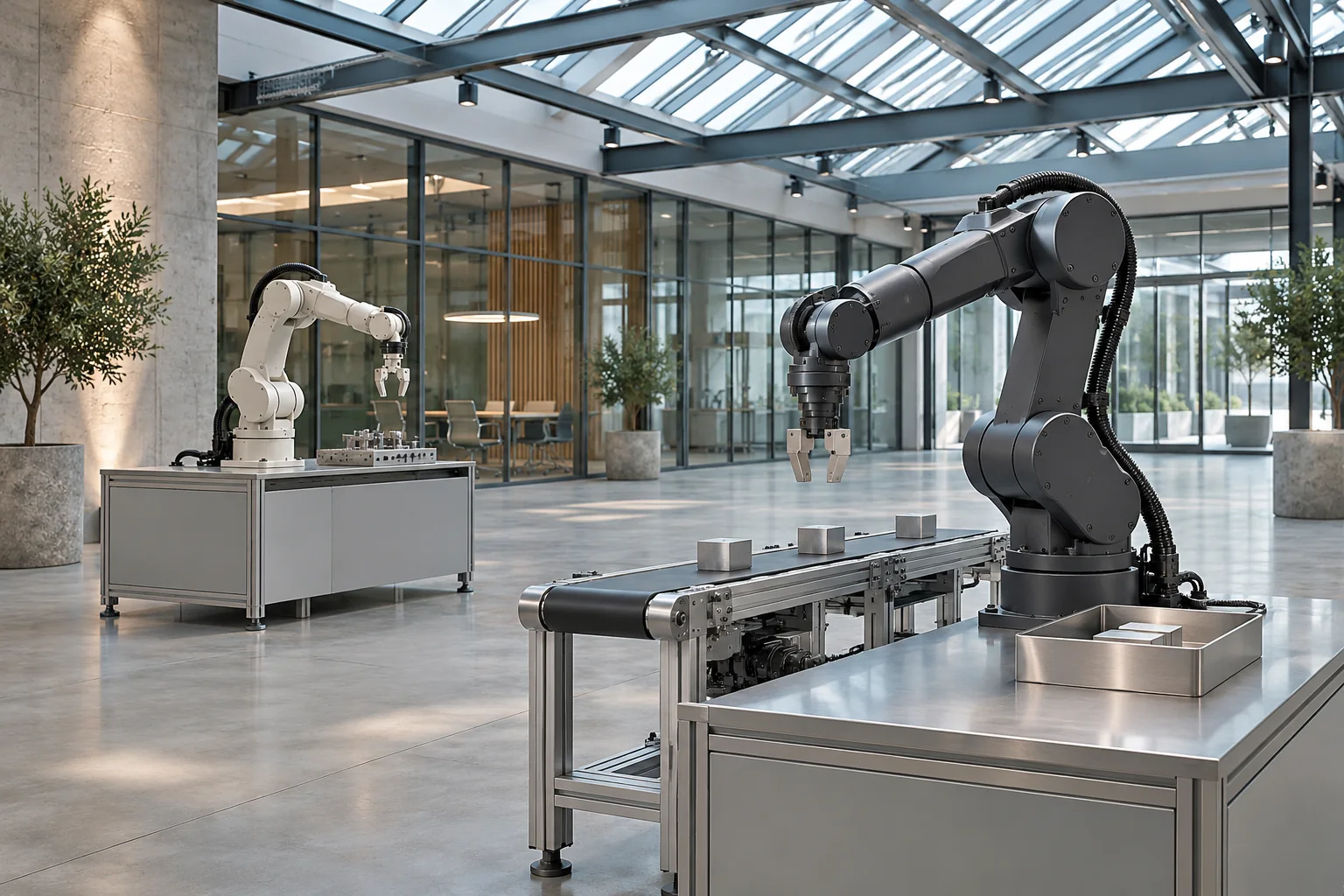
Will this complete cell deliver acceptable output and recover predictably in the intended application?
Treat repeatability, absolute accuracy and finished-part quality as different questions.
Measure accepted output with sensing, machine waiting and recovery included.
Evaluate access to software, diagnostics and local support before accepting integrator dependence.
Market evidence
Reporting periods and statistical scope are shown for each figure.
- 2025 · ChinaNew annual installations
354,000industrial robots
A large domestic application base justifies investigating more hardware options, without assuming export readiness.
IFR installation count; not factory production, shipments or humanoid-robot sales.
Source 1- 2025 · ChinaDomestic manufacturers’ share of Chinese industrial-robot installations
55%
Chinese suppliers are established in their home market; overseas service and integration still require separate assessment.
Source 1- August 2025 snapshot · Bao’an, ShenzhenCore robot-component companies in district reporting
83key enterprises
Component specialists can be assessed separately from a complete-cell integrator.
Part of 210 key robotics enterprises reported by the district; not every registered company.
Source 2- End-2024 · Wuzhong, SuzhouRobot-body manufacturers in the district
45manufacturers
The region offers more than one hardware or integration path.
Includes different robot categories; not 45 equivalent industrial-arm suppliers.
Source 3
The market is established; the application is still yours
IFR reports 354,000 new industrial-robot installations in China in 2025 and a 55% domestic supplier share. The opportunity is therefore broader than finding an unfamiliar low-price arm: buyers can investigate suppliers operating within a substantial home application market. Those figures do not establish support coverage, application suitability or conformity in Europe. 1
The geography also has layers. Bao’an’s August 2025 district interview distinguishes 83 core-component enterprises from 72 industrial-robot enterprises. Wuzhong reported 45 robot-body manufacturers at the end of 2024, within a wider robotics and AI ecosystem. A visit can examine where capability sits between actuator, arm, controller and system integrator, rather than confusing an attractive showroom with ownership of the whole solution. 2 3
MANUFACTURING GEOGRAPHY
The specification that looks decisive may not decide the job
Dobot’s public CRA specification lists ±0.02 mm repeatability for the CR5A and qualifies its data as laboratory results under particular conditions. That is a model-specific manufacturer statement, not evidence that a finished assembly will achieve the same tolerance. 4
Repeatability concerns returning to a position; a process also depends on how the tool, workpiece and reference frame are located. For insertion, a small location error can matter more than repeatability. For machine tending, access, payload at the actual tool configuration and recovery from a misgrip may dominate. For polishing, contact behaviour and the path over the surface matter. The technical evaluation must start with the operation and let qualified engineers select the relevant measures.
An application trial should use representative parts and the intended end-effector, with the actual machine interface where feasible. A carefully presented rigid block is useful for showing motion, but it leaves feeding variability, gripping and process control unanswered.
Count good parts while the cell is doing all its work
A commercial throughput model should include sensing, gripping, process time, machine handshakes and transfers. Some activities overlap; simply adding every duration can overstate the cycle. Conversely, timing only the arm movement understates it. The comparison should use the critical path of the complete operation, then account separately for stops, recovery and rejected work.
Mitsubishi’s simulation documentation explicitly distinguishes simulated motion time from actual operation and instructs users to account for input waiting. The precise figures in that older software manual are not transferable to another robot; the enduring lesson is that a motion estimate is not a complete production-cycle promise. 5
A slower nominal cycle can be commercially preferable if it permits more reliable feeding or simpler recovery. Test that proposition with observations rather than assuming either speed or simplicity wins. Record the parts, programme, operating mode and intervention conditions so the comparison can be reproduced.
The integrator is part of the asset
A complete cell contains accumulated application knowledge: vision settings, fixtures, gripper geometry, PLC logic and recovery procedures. If only one supplier can access or modify it, a lower hardware price may be offset by a narrow maintenance route. Ask who owns the programme, which licences renew, what is backed up and how a controller replacement restores operation.
The most revealing demonstration can be an ordinary interruption: a missing part, a dropped signal or a power restart, introduced under an agreed safe test procedure. Have the designated operator explain how the state is recognised and recovered. The point is to understand maintainability and the boundary between routine support and specialist intervention.
For EU projects, the date of placing machinery on the market also matters. The European Commission states that the Machinery Regulation applies from 20 January 2027, with the current directive governing machinery placed on the market before that date. A qualified conformity specialist should determine the obligations for the particular cell and date; a component certificate does not settle the integrated application. 6
A useful visit resolves the application uncertainty
Spend the visit on the operation most likely to defeat the business case, then evaluate the supplier’s ability to diagnose it. An excellent tour that never exposes the difficult part leaves the central investment question open.
The visit should produce a reproducible application result, a credible accepted-output model and an agreed support boundary. The hardware brand matters, but the durable asset is a working cell that the owner can operate, recover and maintain.
What a demonstration proves—and what still needs work
| Observed result | What it supports | What remains open |
|---|---|---|
Repeated unloaded movement | Motion demonstration | Tool, load, process and workpiece behaviour |
Successful part cycle | Feasibility under the shown conditions | Variation, failures and sustained accepted output |
Fast simulated path | Candidate motion strategy | Handshakes, safety configuration and recovery |
Remote supplier diagnosis | One support interaction | Availability, permissions, spare parts and local ownership |
Where to intervene
Design the decisive demonstration
Before confirming the visit agenda
Choose the application condition with greatest technical or economic uncertainty.
Agree representative parts, tooling, safe interruptions and recorded evidence.
- Working output
A demonstration protocol tied to the application.
- Decision test
The technical team accepts that the trial tests the difficult operation.
Price the integration dependency
After application feasibility is understood
Map control software, licences, backups and recovery ownership.
Obtain support and spare-part commitments for the destination market.
- Working output
A maintainability and support model.
- Decision test
The operating team can identify who restores the cell after each material failure.
Measures that make the decision testable
- Accepted output per scheduled hour
Conforming completed parts divided by scheduled cell hours, including observed stops.
Compare with the application business case; separate measured trials from extrapolated shifts.
- Recovery time by failure mode
Time from a defined safe interruption to resumed accepted production.
The operating team sets acceptable limits for its staffing and downtime exposure.
From analysis to a working brief
XYU can structure a China visit around agreed technical questions, identify relevant hardware and integration companies, arrange demonstrations subject to access and coordinate interpretation and follow-up. It can collect commercial support information and keep a clear distinction between observed evidence, supplier claims and unresolved engineering issues. Technical feasibility, functional safety, system integration and conformity assessment require the buyer’s engineers and appropriately qualified specialists. XYU’s role is to make local meetings and subsequent information exchange useful to those decisions, rather than to approve the automation system.
Sources & methodology
This analysis draws on the sources below. Figures retain each source’s reporting period, product category and geographic scope. Commercial recommendations and decision frameworks are XYU’s analysis.
- World Robotics 2026: industrial robot installations in 2025
International Federation of Robotics · 24 September 2026
354,000 Chinese installations, 59% global share and 55% domestic supplier share; annual industrial-robot flow.
- Bao’an robotics industry: official district interview
Shenzhen Government / Bao’an Science and Technology Innovation Bureau · 14 August 2025
210 key companies, including 83 component and 72 industrial-robot enterprises; sector distinctions.
- Wuzhong robotics cluster: end-2024 structure
Suzhou Municipal Government · 12 August 2025
45 robot-body manufacturers at end-2024 and cluster breadth; not industrial-arm-only output.
- CRA series technical specifications
Dobot
CR5A repeatability and the manufacturer’s laboratory-condition qualification.
- Industrial robot simulation manual: cycle-time calculation
Mitsubishi Electric
Section 10.2: simulation versus actual cycle time and signal waiting; historical technical reference, not a benchmark.
- Machinery legislation and transition dates
European Commission
20 January 2027 application date and current-directive transition; specialist project assessment required.