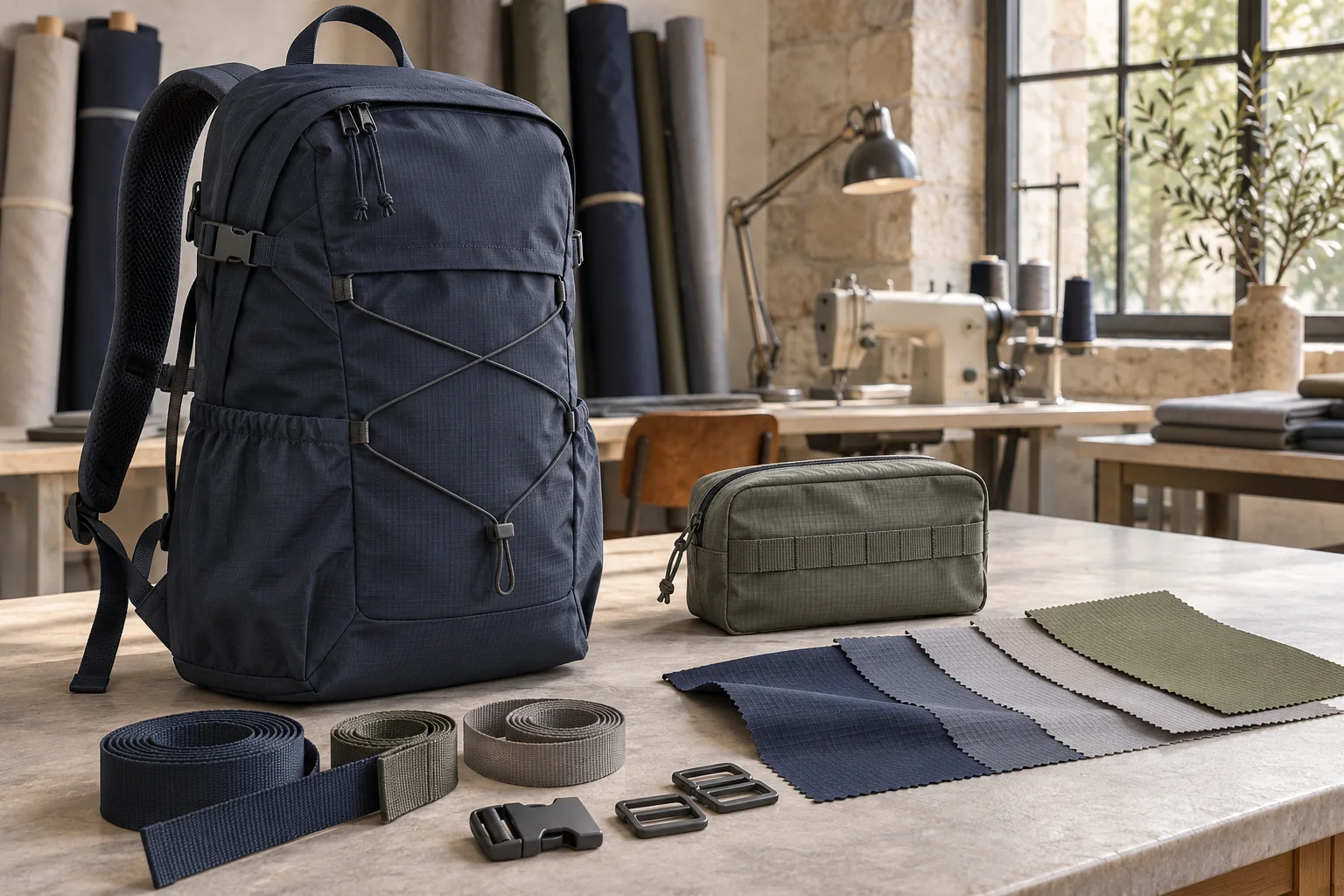
Are you selling protection from a passing shower, sustained rain or immersion—and what does that choice do to the construction and cost?
Specify exposure at the finished-product level; a fabric result cannot establish the performance of a zip or seam.
Concentrate early demand on shared materials and trims before paying for a wide colour palette.
Select the joining process before selecting the factory: sewn and sealed bags require different production evidence.
Market evidence
Reporting periods and statistical scope are shown for each figure.
- 2024 · ChinaSports goods and related manufacturing output
1.5251RMB trillion
Production depth creates options; factory capability remains product-specific.
Gross output across sports goods; not retail sales or outdoor-bag demand.
Source 1- 2025 · China; reporting units above the designated sizeSports and recreation goods retail growth
+15.7% year on year
Domestic demand is relevant context for supplier priorities.
Nominal broad-category growth among larger reporting units; not an outdoor-only or European demand forecast.
Source 2- Annual scale reported in June 2026 · Shiling, GuangzhouBags and leather goods produced in Shiling
>700million units annually
A substantial sewn-bag ecosystem; sealed construction needs distinct evidence.
Local-government annual-scale estimate covering bags and leather goods, not technical outdoor capacity.
Source 3
The opportunity is in product definition, not the number of factories
China has an established sports-goods manufacturing base and growing domestic sports and recreation retail activity. Those statistical categories measure different things and do not establish the size of the outdoor-bag market. 1 2 A European entrant needs a well-defined reason to buy its product.
Shiling offers a documented chain spanning bag materials, design and manufacture. 3 That breadth is relevant to sewn day packs and organisers; specialist sealed constructions require distinct process evidence. Define the customer’s use before deciding which manufacturing capability to investigate.
MANUFACTURING GEOGRAPHY
- Shiling, Guangzhou
A documented bag and leather-goods production ecosystem; a starting point for sewn-product capability, with technical outdoor performance assessed separately. 3
Follow the path water takes through the bag
Start with a plain-language promise: commuting through rain, carrying damp swimwear, protecting a dry change of clothes at a campsite, or temporary immersion. Each use imposes different demands on fabric, joins and closure. ISO 811 measures fabric resistance to water penetration under pressure; Intertek distinguishes that measurement from a spray test assessing surface wetting. 4 5
Map the assembled design’s water paths: needle holes, zipper ends, tape junctions, reinforcement patches and roll-top edges. Ask a competent laboratory to develop a finished-product exposure protocol reflecting the claim, including the closure instructions the customer will receive. Compare performance before and after agreed conditioning representative of folding, abrasion and cleaning. The commercial decision may be to narrow the claim, change a vulnerable join, or fund a different construction. Adding a stronger fabric without addressing the leaking closure is unlikely to solve the actual problem.
Choose the seam before negotiating the unit price
A sewn-and-bound organiser, a sewn bag with sealed seams and a welded dry bag are different manufacturing propositions. For each design, identify which operation creates its essential function and who controls that operation. For a sealed construction, discuss material compatibility, access around curves and reinforcement junctions, and the evidence that the chosen process remains consistent across production.
Keep the product specification explicit about the fabric construction, coating or laminate, backing, thread, tape, closure and hardware. Use material identities that allow replacements to be compared technically. SATRA’s luggage guidance treats outer fabric, seams, fasteners, straps and assembly as distinct testing considerations. 6 Separate base material, extra joining operations, seam treatment, rejected work and finished-product verification, so an apparently cheaper proposal cannot quietly remove the operation that supports the claim.
Colour complexity can consume the launch budget
The relevant minimum order may sit upstream at a dyed fabric, printed panel or custom zip, rather than at final assembly. Request minimum quantities and residual-material ownership for each shared component. Build the range around a common fabric and trim platform where that fits the brand; introduce differentiation through components that do not force a separate material batch.
Value unconsumed fabric and trims by colour at their purchase cost, and record their expected recoverable value separately. Then map when material, sampling and production payments fall due against expected customer receipts. This exposes a trade-off that a single finished-unit quotation hides: a lower unit price may require a much larger cash commitment. Retain colours with evidence of demand, and price the extra complexity explicitly.
Design the claim around the weakest useful feature
A bag that keeps rain out but fails at its shoulder-strap attachment still fails its user. Prioritise loaded carrying, abrasion at contact points, zip operation and colour transfer alongside water performance. SATRA identifies tear, puncture, seam strength and colour-fastness assessments as relevant to luggage materials. 6 Translate those categories into a test brief for the actual design and intended load, for the intended use.
Connect the claim, its construction and the economics of repeating it. Maintain a retained reference with its material identities and test conditions, then require a technical review when a coating, joining process or closure changes. Protective equipment, climbing equipment and flotation products require a separate product-specific assessment; this analysis concerns non-protective bags and leisure accessories.
Construction decisions that change both the claim and the manufacturing model
| Product promise | Engineering priority | Commercial consequence |
|---|---|---|
Everyday organiser | Loaded seams, zip access, abrasion and colour transfer | Spend on useful durability; avoid paying for unsupported water claims. |
Rain-resistant day bag | Finished-product ingress paths and closure instructions | Cost the seam and closure treatment alongside the fabric. |
Sealed dry bag | Joining compatibility, closure geometry and agreed whole-product exposure | Select specialist joining capability and fund claim-specific verification. |
Seasonal colour expansion | Shared material consumption and batch commitments | Approve incremental cash exposure as well as finished-unit price. |
Where to intervene
Resolve the water promise
Before the range’s construction and public claims are fixed
Map the intended exposure, closure instructions and likely water-entry paths.
Compare construction options through an appropriate finished-product test protocol.
- Working output
A supported product claim, construction choice and cost comparison.
- Decision test
Proceed only with a claim supported by the chosen complete construction.
Make the assortment financeable
Before committing to dyed fabrics, custom trims or production quantities
Calculate unused fabric and trim exposure by colour.
Identify variants that can share materials without weakening the product.
- Working output
A range-level material and cash commitment model.
- Decision test
Release the assortment only when its expected demand justifies its component commitments.
Measures that make the decision testable
- Finished-product ingress result
Water entry by location under the agreed exposure, closure and conditioning protocol.
The exact public claim and laboratory-agreed test conditions.
- Residual material exposure
Committed fabric and trim value not consumed by approved demand, by colour and component.
Cash budget, demand confidence and practical reuse options.
- Loaded attachment performance
Strap, handle and joining behaviour under the agreed load and conditioning.
Intended use, construction and laboratory advice.
From analysis to a working brief
XYU can translate the intended product and price position into a China-side manufacturing enquiry, identify relevant sewing or joining capabilities, and coordinate material information, technical discussions and prototype feedback. We can make component commitments and differences between quotations visible to the brand, then arrange agreed external testing and follow-up. Product engineers and qualified laboratories define and assess specialist performance requirements. The brand retains decisions on its range, claims and purchasing; XYU’s role is to connect those decisions to the people and processes required to execute them.
Sources & methodology
This analysis draws on the sources below. Figures retain each source’s reporting period, product category and geographic scope. Commercial recommendations and decision frameworks are XYU’s analysis.
- 2024 national sports-industry output and value added
National Bureau of Statistics and General Administration of Sport of China · 31 December 2025
Table: sports goods and related manufacturing gross output RMB 15,251 hundred million; distinction between output and value added.
- December and full-year 2025 retail sales
National Bureau of Statistics of China · 19 January 2026
Full-year sports and recreation goods retail growth 15.7%; designated-size reporting scope and nominal measure.
- Shiling’s bag and leather-goods industrial ecosystem
Shiling Town Government, published by Huadu District Government · 9 June 2026
Annual bag and leather-goods production above 700 million; documented materials-to-manufacturing industrial chain.
- ISO 811:2018 — resistance to water penetration
International Organization for Standardization · 2018-03
Scope: hydrostatic pressure testing of fabrics; confirmed current in 2025.
- Water repellency testing
Intertek
Distinguishes surface wetting/spray performance from water-resistance evaluation.
- Testing luggage
SATRA
Materials, seams, fasteners, straps, colour fastness and whole-product testing considerations.