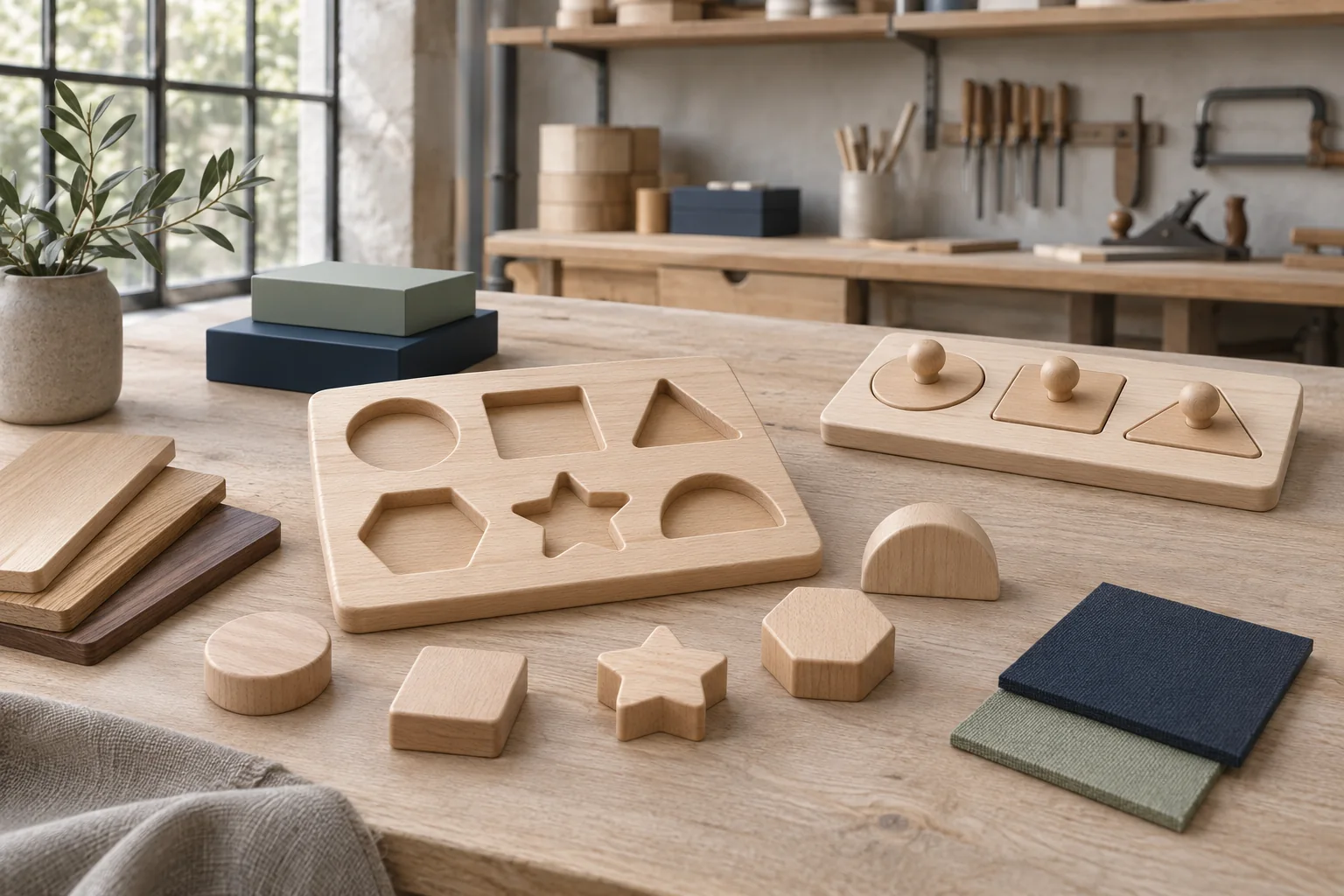
Which parts create real play value, and which merely increase the number of ways the product can fail?
Design the intended play activity and age suitability before fixing the component architecture.
Track evidence by material, finish and product configuration, rather than collecting unrelated test reports.
Use modularity to simplify the learning system; do not let extra pieces become the product’s only selling point.
Market evidence
Reporting periods and statistical scope are shown for each figure.
- 2024 · Yunhe countyAbove-size wooden-toy industrial output
2.65billion RMB
A specialist wooden-toy ecosystem supports process-specific development.
Above-size manufacturers only; not the larger all-enterprise wooden-toy cluster estimates.
Source 1- 2024 · Yunhe countyAbove-size wooden-toy export delivery value
0.80billion RMB
Export-oriented production is established, but customer-specific evidence still matters.
Export delivery value is a factory statistical measure, not customs-cleared exports.
Source 1- 2024 · Chenghai districtAbove-size toy-creative industrial output
14.091billion RMB
A wider toy ecosystem offers different material and assembly routes.
Toy-creative category includes more than non-electronic learning toys.
Source 2- 2024 · Chenghai districtToy exports including new trade formats
10.24billion RMB
A substantial export network does not make every product suitable for every age group.
Official local customs-based series; different scope from industrial output and Yunhe export delivery value.
Source 3
More pieces are not the same as more learning
A sorting activity, sequencing game and construction set ask children to do different things. Combining them can create useful play, but it can also produce a crowded box whose educational promise is difficult to explain. The design question is what the child actually does, what a caregiver observes and which features are essential to that activity. Claims about learning outcomes need their own support; they do not follow automatically from a wooden material or a familiar educational label.
Build the product architecture from the intended activity. Each extra shape, coating colour, magnet, cord or moving connection should have a clear purpose. If it adds little to the play, removing it can reduce both manufacturing complexity and the number of technical questions that must be resolved.
MANUFACTURING GEOGRAPHY
- Yunhe, Zhejiang
Specialised wooden-toy manufacturing and supporting processing services.
- Chenghai, Guangdong
Broader toy-creative manufacturing ecosystem, including moulded and assembled products.
Wood and moulded products carry different production questions
Yunhe's market-regulation authority reports 2024 above-size wooden-toy output of RMB 2.65 billion and export delivery value of RMB 0.80 billion. Chenghai's official figures separately record RMB 14.091 billion of above-size toy-creative output and RMB 10.24 billion of toy exports including new trade formats. These measures have different scopes: industrial output, factory export delivery and customs-based exports are not interchangeable or additive. 1 2 3
The useful distinction is the work to be controlled. A wooden puzzle raises questions about shaping, surface preparation, coating and how pieces fit after finishing. A moulded sorting set adds tool geometry, cavity identification and assembly interfaces. Selecting a cluster should follow those mechanisms. The size of the wider toy ecosystem cannot substitute for understanding the exact material and construction of the intended learning product.
Age suitability changes the product, not only the label
An age statement influences the design assumptions and the assessment of foreseeable use. It should not be selected late merely to avoid an inconvenient test. EU toy legislation addresses general and specific safety risks; the product's classification and applicable requirements need to be established by the accountable manufacturer or importer with qualified support. 4
For a non-electronic learning set, examine the product as children may handle it: pulling a peg, mouthing an accessible part, dropping a board or mixing pieces with another set. These are prompts for the qualified assessment, not substitutes for it. A magnetic feature, detachable knob or cord can change the questions materially. The commercial judgement is whether the play value justifies the added design, evidence and continuing manufacturing-control burden.
One report cannot describe an uncontrolled family of variants
A test report is useful when the assessed item can be connected to the product actually supplied. The relevant relationship includes construction, material identity, coatings, printing and configuration. A family of visually similar toys may need a deliberate assessment of which variants can share evidence and which cannot. Let the competent specialist make that determination; do not assume colour changes or additional pieces are automatically covered.
The technical framework also evolves. SGS's 2026 notice describes changes to EN 71-1 mechanical and physical toy requirements, including new provisions for food-imitating toys. Publication of a revised standard and its legal harmonisation are separate events. Confirm the version and transition applicable at the actual placing-on-market date rather than repeating a standard number from an old supplier brochure. 5
Build a product family that can remain controlled
The new EU Toy Safety Regulation entered into force on 1 January 2026 and is due to apply from 1 August 2030. Its digital-product-passport framework is therefore not a general current obligation for all toys in November 2026. That future transition strengthens the argument for organised product information today, without pretending the later requirements already apply. 4
For the range itself, favour a manageable set of meaningful configurations. Shared shapes or boards can support extensions where the specialist assessment allows, while replacement-piece design can improve usability after purchase. Keep replacement compatibility and version identity explicit. The stronger commercial proposition is a learning system that people understand and can keep using, with an evidence trail that still describes it after the next colour, supplier or component change.
Features worth challenging at the design stage
| Feature | Possible play value | Additional question |
|---|---|---|
Extra coating colours | Recognition or sorting | Which material/finish variants require evidence? |
Detachable knobs or connectors | Grasping or construction | How does foreseeable use affect the assessment? |
Magnetic pieces | Assembly or positioning | Does the activity justify the additional safety analysis? |
Shared boards and replacement pieces | Extensions and longer use | Are fit, version and evidence compatibility controlled? |
Where to intervene
Challenge the component architecture against the play activity
Before committing to the final part count and materials
Describe the intended activity and audience without unsupported educational claims.
Remove features that do not justify their manufacturing and assessment burden.
- Working output
A play-to-component rationale with the qualified assessment questions identified.
- Decision test
Retain each feature only when its purpose and technical evaluation route are clear.
Connect the product family to its evidence
Before approving variants or subsequent material changes
Map materials, finishes and configurations to the specialist-defined evidence scope.
Define replacement-piece compatibility and the changes that trigger review.
- Working output
A controlled variant and evidence map.
- Decision test
No variant is released on the assumption that an unrelated report covers it.
Measures that make the decision testable
- Evidence-covered configurations
Approved configurations connected to applicable assessment evidence divided by configurations proposed for release.
The responsible specialist defines valid coverage and the assessment scope.
- Manufacturing complexity per activity
Distinct controlled materials, finishes and interfaces required for each defined play activity.
Use to compare design alternatives; fewer components are valuable only if play and safety are preserved.
- Replacement compatibility
Replacement items matching the approved product version and fit requirements divided by assessed replacements.
Set the reference to the actual product system and approved specialist criteria.
From analysis to a working brief
XYU can support sourcing for non-electronic learning products by connecting the proposed material and construction to appropriate Chinese manufacturing capabilities. We can coordinate technical discussions, prototypes, material records and independent testing requested by the responsible parties, while maintaining the link between assessed configurations and supplier changes. Educational claims, age suitability, toy safety assessment and legal conformity remain with the accountable brand, manufacturer or importer and qualified specialists. Our contribution is practical manufacturing coordination that keeps the approved product definition intact.
Sources & methodology
This analysis draws on the sources below. Figures retain each source’s reporting period, product category and geographic scope. Commercial recommendations and decision frameworks are XYU’s analysis.
- Yunhe wooden-toy industry quality development
Yunhe Market Regulation Bureau, Zhejiang quality-service platform · 11 March 2025
The 2024 above-size wooden-toy figures are RMB 2.65 billion of industrial output and RMB 0.80 billion of export delivery value.
- Chenghai toy-creative industrial performance
Shantou Industry and Information Technology Bureau · 28 February 2025
Above-size toy-creative businesses in Chenghai recorded RMB 14.091 billion of industrial output in 2024.
- Chenghai toy-export and cross-border trade development
Shantou Municipal Government · 26 March 2025
Chenghai reported RMB 10.24 billion in toy exports, including new trade formats, in 2024.
- EU toy-safety legislation and transition
European Commission
The current toy-safety framework and the transition to Regulation 2025/2509, which entered into force on 1 January 2026 and applies from 1 August 2030.
- EN71-1:2026 mechanical and physical toy requirements
SGS · 2026-02
The EN 71-1:2026 revision includes food-imitating toys; publication of a standard and its harmonisation under EU law are separate steps.